Rind of the watermelon.
I was at the microwave warming up my lunch when I noticed an unusual vegetable in my colleague's lunchbox. It looked like small slivers of peach, an inch long, 1/8'' thick, yellow with a red tinge on the inner curve. I was pretty certain that it wasn't peach though, so I asked him.
He told me that it was watermelon. After scooping out the delicious red part, you are left with the rind which is normally discarded. If you took off the hard green exterior though, you have that white/red transition part that is usually hard and not very tasty. She sliced that part up and probably just stirfried it.
I'm going to have to look this up when I have a little more time. They are Chinese, so I assume it might be a Chinese dish even though I've never heard of it.
Thursday, May 29, 2008


Monday, May 5, 2008
Best mango bubble drink is in Chinatown
I usually go to Chinatown for a meal if I'm downtown catching a movie, simply because I don't know where else to go. I've recently decided on my favorite drink to sneak into the theaters: the mango bubble from a shop simply named "Vietnamese sandwich and bubble tea" located on ~50 Harrison Ave in Chinatown.
The mango bubble comes with mango juice, mango chunks and a scoop of mango ice cream blended together and poured over tapioca pearls with a good chewy consistency. At $3.50, it's the same price as most places, but it's way more value for money. This is the only place I've found (so far), that doesn't give me a fruity syrup and ice and calls it a mango bubble.
If you know any other place that serves real fruit and stuff in their bubble teas, let me know. Thanks!
PS. I do not recommend the bubble tea in the Porter Exchange Mall -- the pearls are squashy, not chewy. They probably used the instant version, which is just wrong.
Sunday, March 30, 2008
A treat from Chinatown
I discovered something new and delicious in the Chinese bakery, and it's not an egg tart. It looks like a giant fluffy marshmallow, but there wasn't a label in the display so I don't have name for it. Let me call it the Chinese mochi.
 It's softer than a Japanese mochi, but still chewy. The outside of the rice dough is dusted with unsweetened shreds of coconut. The rice dough is barely sweet, possibly unsweetened. The inside is a filling of sesame seeds, peanut bits, shredded coconut and sugar. It's sweet, but not overwhelming such that when you chew it, everything blends harmoniously. The smooth chewy outside contrasts well with the crunch of peanuts, the occasional sugar granule, and the rough coconut bits. It's roughly half the size of my fist, which is kinda huge. Just one makes an ample treat. At 70 cents a piece, it's a bargain.
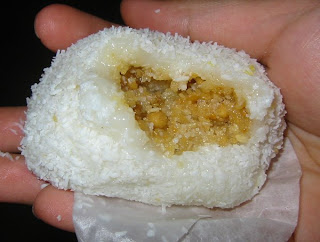
I got mine at Ho Yuen Bakery in Boston's Chinatown, but it must be available elsewhere. I've been there twice, and it seems to sell out a little past mid-afternoon on Saturdays. I think they will look lovely in a box for the next time I need to bring snacks to a friend's place.


I got mine at Ho Yuen Bakery in Boston's Chinatown, but it must be available elsewhere. I've been there twice, and it seems to sell out a little past mid-afternoon on Saturdays. I think they will look lovely in a box for the next time I need to bring snacks to a friend's place.
Wednesday, March 26, 2008
Sundubu Chigae
A warm and comforting food. It was actually the first Korean food I've ever had. I was 19, and I was in Monterey Park, CA. My family and I were on vacation, and we were starving. Somehow we ended up at a place unremarkably called Lee's Tofu (is it still there?) that served the first and best tofu soup in my memory. I've since tried tofu soups in a couple of other Korean places, but I couldn't find anything quite as good. I like cooking my own food, and finally 2 years ago, I decided that I would venture into the unfamiliar world of Korean cuisine. The result -- a cheap and simple dish that doesn't require too many exotic ingredients that I can't reuse. (Note: I consider soy sauce and sesame oil kitchen staples.)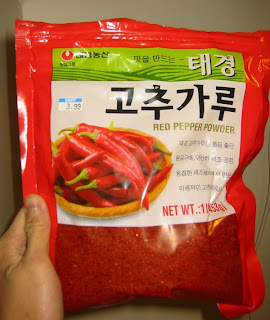
You do have to buy 1-2 special things from the Korean grocery store, depending on which recipe you choose. But I guarantee that you can use these special ingredients again.
The special ingredients: 1. red pepper flakes (mandatory); 2. gochujang (red pepper paste)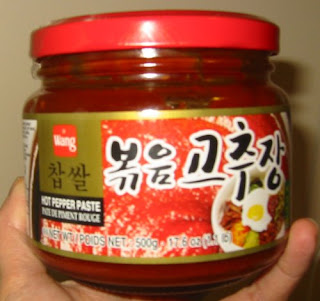
Red pepper flakes -- available at a Korean grocery store in huge 1-- 3lb bags (I was surprised when I first got my bag : see Understanding Koreans.) Ask the store if you're uncertain which type to get -- tell them that you're making soup. You can store your bag in the freezer.
Gochujang -- available at a Korean grocery store, possibly a larger Chinese supermarket. I use the seasoned one, mixed with sugar and sesame oil (my brand is Wang's). If you use those from the red boxes, they are way spicier (beware) and you should probably add some sugar and sesame oil to your recipe.
Pork and Kimchi Sundubu Chigae
1 16oz package of silken tofu (quartered)
~4oz pork meat (thinly sliced)
8oz kimchi, diced (you can use the entire 16oz jar if you can't figure what else to do with it)
1 egg
1 scallion thinly chopped (optional)
Meat seasoning: 1/2 tsp salt, 1/2 tsp chopped garlic, 1/2 tsp sesame oil, ground black pepper
Soup seasoning: 2-3 tsp red pepper flakes, 1 tbsp soy sauce, 1/2 tsp salt, 1tsp chopped garlic, ground black pepper
1/2 cup water
oil
If you bought a chunk of pork, here is an easy way to slice it thin (requires advance preparation): freeze the chunk of pork, and then let it thaw for 4-8 hours in the fridge. The pork will then be hard enough to provide "support", while being soft enough for you to easily cut it.
1. Season pork with the meat seasoning.
2. Add 1/2 tbsp oil (olive works) to pot on medium-high heat, add pork and kimchi. Stir for a couple of minutes.
3. Reduce heat to medium. Add water, tofu, and soup seasoning. Mix gently.
4. Allow the soup to come to a boil, then lower heat to med-low. Let that simmer for another ~30 -- 45 minutes.
5. Before serving, crack an egg over the soup and stir gently. Sprinkle scallions to garnish. Serve with rice.
Seafood Sundubu Chigae
(I'm using shrimp and fish, but you could probably also use scallops and squid as well. Mix those 4 up!)
1 16oz package of silken tofu
1/4 lb shrimp, shelled
1/4 lb cod fillet (I like cod, and I haven't experimented with other fish)
1 egg
1 scallion (optional)
Seafood seasoning: 1/4 tsp salt, ground black pepper
Soup seasoning: 2 tsp red pepper flakes, 2-3 tsp gochujang (reduce to 1/8 if you're using real gochujang), 1/2 tsp salt, 1/2 tsp garlic, ground pepper
1/2 cup water
oil
1. Cut seafood into bitesized pieces. Add seasoning and mix.
2. 2. Add 1/2 tbsp oil (olive works) to pot on medium heat, add seafood. Stir for a couple of minutes.
3. Reduce heat to medium. Add water, tofu, and soup seasoning. Mix gently.
4. Allow the soup to come to a boil, then lower heat to med-low. Let that simmer for another ~15 -- 30 minutes.
5. Before serving, crack an egg over the soup and stir gently. Sprinkle scallions to garnish. Serve with rice.

You do have to buy 1-2 special things from the Korean grocery store, depending on which recipe you choose. But I guarantee that you can use these special ingredients again.
The special ingredients: 1. red pepper flakes (mandatory); 2. gochujang (red pepper paste)

Red pepper flakes -- available at a Korean grocery store in huge 1-- 3lb bags (I was surprised when I first got my bag : see Understanding Koreans.) Ask the store if you're uncertain which type to get -- tell them that you're making soup. You can store your bag in the freezer.
Gochujang -- available at a Korean grocery store, possibly a larger Chinese supermarket. I use the seasoned one, mixed with sugar and sesame oil (my brand is Wang's). If you use those from the red boxes, they are way spicier (beware) and you should probably add some sugar and sesame oil to your recipe.
Pork and Kimchi Sundubu Chigae
1 16oz package of silken tofu (quartered)
~4oz pork meat (thinly sliced)
8oz kimchi, diced (you can use the entire 16oz jar if you can't figure what else to do with it)
1 egg
1 scallion thinly chopped (optional)
Meat seasoning: 1/2 tsp salt, 1/2 tsp chopped garlic, 1/2 tsp sesame oil, ground black pepper
Soup seasoning: 2-3 tsp red pepper flakes, 1 tbsp soy sauce, 1/2 tsp salt, 1tsp chopped garlic, ground black pepper
1/2 cup water
oil
If you bought a chunk of pork, here is an easy way to slice it thin (requires advance preparation): freeze the chunk of pork, and then let it thaw for 4-8 hours in the fridge. The pork will then be hard enough to provide "support", while being soft enough for you to easily cut it.
1. Season pork with the meat seasoning.
2. Add 1/2 tbsp oil (olive works) to pot on medium-high heat, add pork and kimchi. Stir for a couple of minutes.
3. Reduce heat to medium. Add water, tofu, and soup seasoning. Mix gently.
4. Allow the soup to come to a boil, then lower heat to med-low. Let that simmer for another ~30 -- 45 minutes.
5. Before serving, crack an egg over the soup and stir gently. Sprinkle scallions to garnish. Serve with rice.
Seafood Sundubu Chigae
(I'm using shrimp and fish, but you could probably also use scallops and squid as well. Mix those 4 up!)
1 16oz package of silken tofu
1/4 lb shrimp, shelled
1/4 lb cod fillet (I like cod, and I haven't experimented with other fish)
1 egg
1 scallion (optional)
Seafood seasoning: 1/4 tsp salt, ground black pepper
Soup seasoning: 2 tsp red pepper flakes, 2-3 tsp gochujang (reduce to 1/8 if you're using real gochujang), 1/2 tsp salt, 1/2 tsp garlic, ground pepper
1/2 cup water
oil
1. Cut seafood into bitesized pieces. Add seasoning and mix.
2. 2. Add 1/2 tbsp oil (olive works) to pot on medium heat, add seafood. Stir for a couple of minutes.
3. Reduce heat to medium. Add water, tofu, and soup seasoning. Mix gently.
4. Allow the soup to come to a boil, then lower heat to med-low. Let that simmer for another ~15 -- 30 minutes.
5. Before serving, crack an egg over the soup and stir gently. Sprinkle scallions to garnish. Serve with rice.
Subscribe to:
Posts (Atom)